Coal Sorting with Online Ash Measurement
Abstract. An online ash analyzer can identify changes in coal quality on a conveyor and direct downstream sort gates to route material to different destinations. The method depends on the coal arriving in distinct segments of low, mid, and high ash. This paper describes the analyzer and gate arrangement, the mining conditions that produce sortable segments, and an example of coal recovery and rejection.
1. Online Measurement and Gate Control
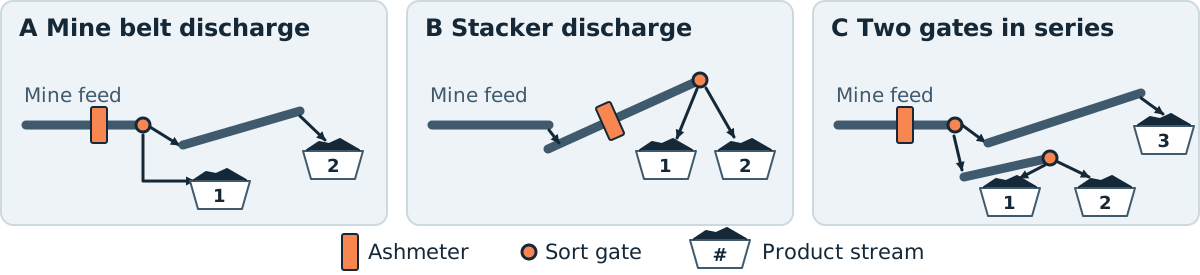
The ETI Model 410M Ash Analyzer measures ash in the raw coal stream. The control system compares the measurement with operator-selected ash setpoints and automatically directs the sort gates to route material into separate stockpiles or batches. In the system described here, one analyzer can control up to three gates and produce up to four separate streams.
The analyzer typically mounts near the end of a mine product belt or on a stacker belt. The shielded source sits above the loaded belt, and the scintillation detector sits between the carrying and return runs. The analyzer measures across the belt without contacting the coal. The analyzer assembly has no moving parts.
Operators select the ash measurement interval based on belt speed, available conveyor length, and how quickly coal quality changes. The control system accounts for the travel time from the analyzer to the downstream transfer point so the gate diverts the segment that was measured.
Figure 1 shows three gate arrangements.
2. Mining Conditions That Favor Sorting
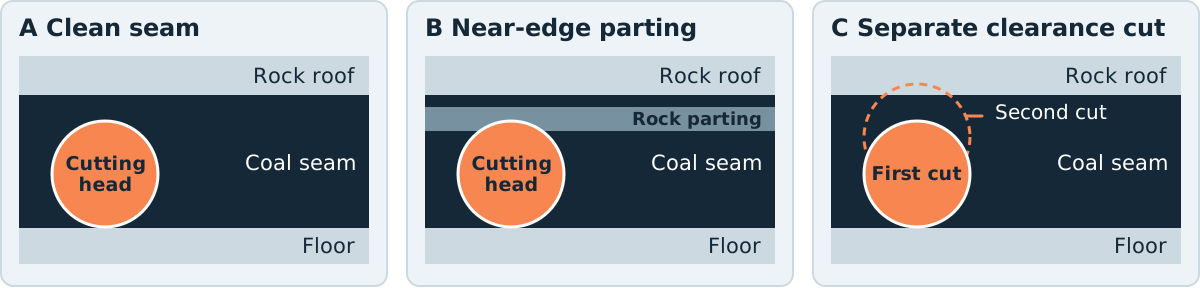
In underground mining, a cutting head operating within a clean seam can produce low-ash coal. Cutting through rock partings within the seam can produce mid-ash material. Cutting roof or floor rock, whether for clearance or incidentally, can produce high-ash segments.
A clean seam thicker than the cutting head diameter is a favorable candidate. A seam at least as thick as the cutting head can also be suitable when a rock parting lies near its upper or lower boundary. Where equipment clearance requires a second cut, cutting the coal first and the roof or floor separately can help keep the material in distinct segments.
Figure 2 illustrates these configurations.
3. Estimating Coal Recovery
Mixing during handling or processing can blur the ash differences between segments and reduce sorting effectiveness. To estimate recovery before installation, observe normal production on the proposed analyzer belt and record the duration of the distinct material segments. Account for differences in belt loading when using segment times to estimate mass recovery.
In the example in Figure 3, all low-ash coal and 75% of the mid-ash coal report to the recovered stream. The high-ash material and remaining mid-ash coal report to reject. The recovered stream represents 69% of the feed at 11.5% ash. The reject represents 31% at 72% ash.

To discuss a coal sorting application or request a site-specific feasibility assessment, contact Energy Technologies Inc. at +1 865-927-9330 or info@energytechinc.com. Visit energytechinc.com for product specifications and additional technical resources.